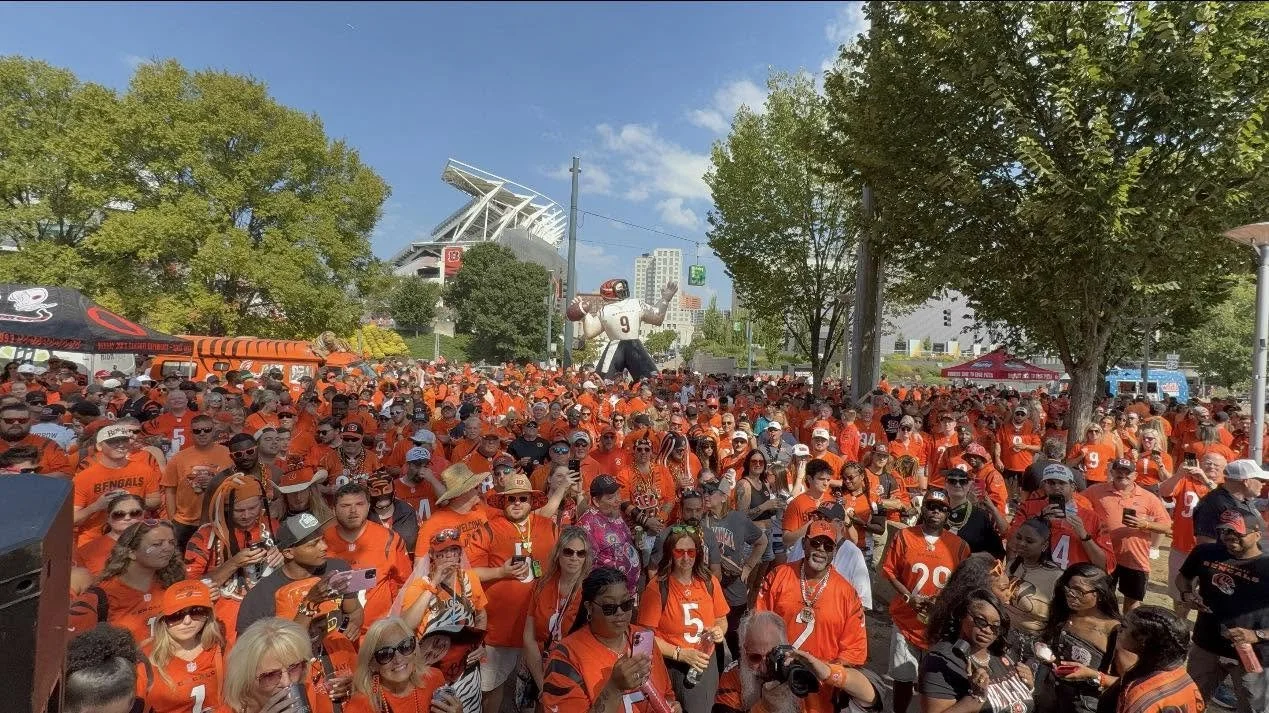
Photo: Bengal Jim’s “Before the Roar” Tailgate Experience
WhoDey Nation by the Numbers
1.31 million
Greater Cincinnati adults who identify as Bengals fans
67.4%
Percentage of the Greater Cincinnati adult market that follows the Bengals
Nearly 696,000
Avid Bengals fans
Nearly 286,000
Adults who attend Bengals games
Nearly 50/50
Gender split among Bengals game attendees
63.2%
Game attendees who purchase NFL logo apparel
73.8%
Bengals attendees who also attend Reds games
2.5X+
Greater representation of $250,000+ households among Bengals attendees
compared with Greater Cincinnati adults overall
3X+
Greater likelihood that Bengals attendees follow FC Cincinnati
Nearly 4X
Greater likelihood that Bengals attendees are Cincinnati Cyclones fans
Nearly 3X
Greater likelihood that Bengals attendees visit Over-the-Rhine
2X+
Greater likelihood that Bengals attendees go to paid concerts
2X+
Greater likelihood that Bengals attendees attend Broadway in Cincinnati shows
85% more likely
Bengals attendees who spend $5,000 or more annually on vacations compared with the overall market
Nearly 60%
Avid Bengals fans who make charitable donations
Source: Nielsen Scarborough PRIME Lingo, Cincinnati, OH, 2026 Release 1. February-July 2025/September 2025-February 2026. Analysis prepared by Game Day Communications.
There may be no more powerful consumer brand in Greater Cincinnati than two words: Who Dey.
The Bengals host the Tampa Bay Buccaneers Sept. 13 in the annual “Open in Orange” game, beginning a home schedule filled with marquee matchups and national television appearances. But one of the most interesting Bengals stories this season may have nothing to do with Joe Burrow's passing yards, Ja'Marr Chase's catches or the AFC North standings.
It is the business of Who Dey Nation.
New Nielsen Scarborough consumer research commissioned by Game Day Communications provides a detailed look at the size, demographics, interests and spending habits of Bengals fans.
The research identifies approximately 1.31 million Greater Cincinnati adults as Bengals fans, representing 67.4% of the adult market. Within that enormous audience are approximately 696,000 avid Bengals fans and 286,000 adults who attend Bengals games.
That's not simply a fan base – It is one of Cincinnati's largest consumer markets.
And the closer fans get to Paycor Stadium, the more valuable that audience becomes to businesses.
The Bengals Ticket Buyer May Surprise You
Among avid Bengals fans, about 61% are men. But among people who actually attend Bengals games, the gender gap nearly disappears, with men representing approximately 52% of attendees.
The stadium audience also becomes younger. Millennials are about 50% more likely to be represented among Bengals attendees than they are among Greater Cincinnati adults overall.
At the same time, adults 70 and older are substantially less represented among game attendees.
Education rises too. Adults with bachelor’s degrees are more than 80% more likely to be represented among Bengals attendees than in the overall Cincinnati adult population.
Then comes perhaps the most important number for marketers.
People living in households earning $250,000 or more are more than two-and-a-half times as likely to be represented among Bengals game attendees as they are in the Greater Cincinnati adult population overall.
That changes the business conversation.
The Bengals fan watching every Sunday and the Bengals customer buying a seat at Paycor Stadium aren't necessarily the same consumer.
Paycor Stadium Is Becoming a More Premium Experience
That audience profile comes at an important time for the Bengals. The 2026 season brings extensive improvements to Paycor Stadium as part of the multi-year renovation program following the new stadium lease between Hamilton County and the Bengals. The improvements include transformed club lounges and suites, upgraded concessions, renovated restrooms, a redesigned Bengals Pro Shop, improved wayfinding and infrastructure improvements.
The Bengals are also expanding premium inventory, including approximately 2,000 new club seats. The people attending Bengals games aren’t simply passionate football fans. They are disproportionately represented among Cincinnati’s affluent, educated and experience-driven consumers. That makes Paycor Stadium valuable not only to the Bengals, but also to companies trying to reach those consumers.
Bengals Fans Are Cincinnati Sports Fans
One of the most striking findings is how much Bengals fandom overlaps with Cincinnati's other sports properties.
Among Bengals game attendees, 73.8% also attend Cincinnati Reds games. Bengals attendees are also more than three times as likely as the average Cincinnati adult to follow FC Cincinnati and nearly four times as likely to be Cincinnati Cyclones fans.
That suggests an important sports-business opportunity. The competition isn't necessarily Bengals versus Reds versus FC Cincinnati.
The bigger opportunity is building relationships with Cincinnati residents who love live sports and live experiences.
A highly engaged Cincinnati sports fan can buy Bengals tickets in the fall, Reds tickets in the summer, FC Cincinnati tickets throughout the soccer season and Cyclones tickets in the winter.
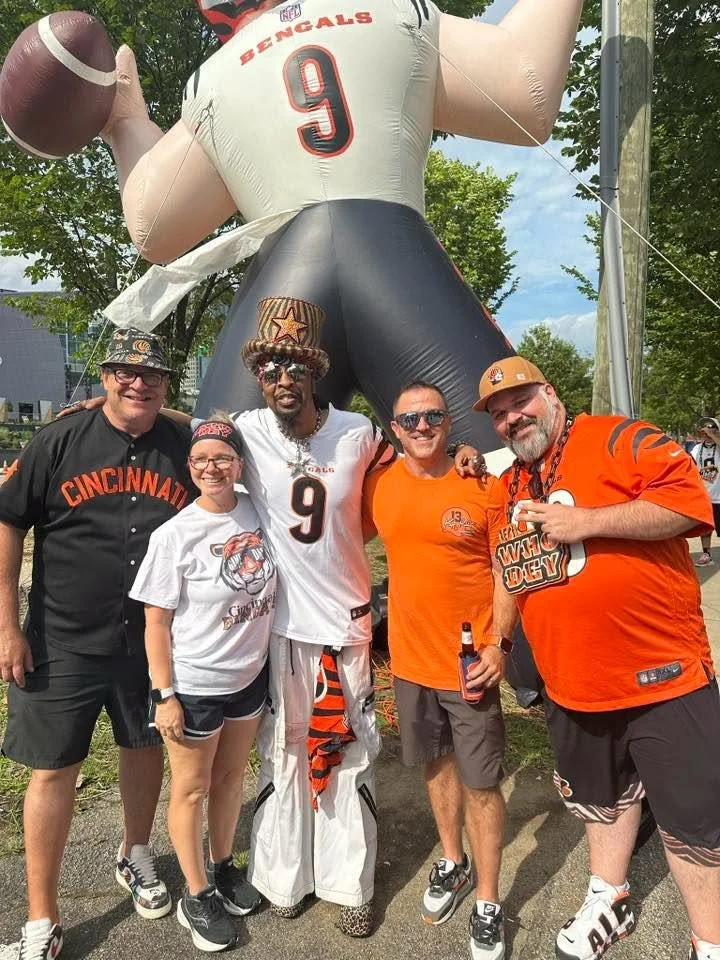
Photo: Bengal Jim’s “Before the Roar” Tailgate Experience
Who Dey Nation Is a Merchandise Business
The Bengals logo is also big business. Nearly 44% of avid Bengals fans purchase NFL logo apparel. Among people who attend Bengals games, that number climbs to 63.2%, meaning nearly two out of every three attendees purchase NFL-branded clothing. And their retail activity goes far beyond jerseys and hats.
Bengals attendees are significantly more likely than the average Cincinnati adult to shop at major retailers including Target, Costco, Best Buy and The Home Depot. They're also more likely to visit Cincinnati Premium Outlets and Kenwood Towne Centre.
Perhaps most interesting for Cincinnati's urban core, Bengals attendees are nearly three times as likely as the average local adult to visit Over-the-Rhine.
That's an important economic connection. The Bengals economy doesn't begin at kickoff or stop when fans leave Paycor Stadium. It extends into restaurants, bars, retail stores, parking facilities, entertainment districts and hotels throughout the region.
The Tailgate Is a Marketplace
Some Bengals consumer behaviors probably won't surprise anyone.
Nearly 70% of avid fans grill or cook outdoors.
Sports-bar usage increases as Bengals engagement increases.
Pizza restaurants are popular.
Skyline Chili has a strong connection with the audience.
And beer remains part of the football experience.
But even within those categories, the research reveals important differences.
Michelob Ultra performs strongly across Bengals fans, avid fans and game attendees. Blue Moon is particularly popular with the stadium audience, with Bengals attendees more than two-and-a-half times as likely as the average Cincinnati adult to consume the brand.
White Claw tells an even more interesting story. Its popularity is relatively ordinary among avid Bengals fans but jumps dramatically among people who attend games, who are more than twice as likely as the average Cincinnati adult to consume it. High Noon also performs strongly across the Bengals audience.
For marketers, the lesson is simple: there isn’t one Bengals consumer. Different segments of Who Dey Nation have different tastes, habits and purchasing power.
The Bengals Fan Is Also a Traveler
The Bengals travel to Madrid to play the Atlanta Falcons Nov. 8, and the consumer research suggests international football may be a particularly good fit for Cincinnati's most engaged fans.
Bengals attendees are 85% more likely than the average Cincinnati adult to spend $5,000 or more annually on vacations. They’re also more than twice as likely to use Hilton properties and nearly twice as likely to fly United Airlines. Foreign travel, premium hotels and all-inclusive resorts become more common as Bengals engagement increases.
That makes the Bengals audience attractive to airlines, hotels, destinations, credit cards, luggage companies and other travel brands.
And Madrid provides an opportunity that didn't exist a generation ago: Cincinnati businesses activating around Who Dey Nation thousands of miles away from Cincinnati.
Football Fans Are Live-Event Fans
Here's another finding that challenges stereotypes.
People attending Bengals games don’t spend all their entertainment money on sports. They’re more than twice as likely as the average Cincinnati adult to attend paid concerts. They’re also more than twice as likely to attend Broadway in Cincinnati series performances and approximately 90 percent more likely to attend live theater.
That makes the Bengals attendee more than a football consumer. They’re a live-experience consumer. That’s significant for Cincinnati's concert venues, theaters, festivals, restaurants, museums and attractions.
The household willing to spend hundreds or thousands of dollars on Bengals experiences may also be buying concert tickets, Broadway subscriptions, restaurant dinners and weekend trips. Sports, arts, dining and travel are all competing for a portion of the same experience economy.
Who Dey Nation Can Be a Force for Philanthropy
The Bengals platform also reaches deeply into Cincinnati's philanthropic community.
Nearly six in 10 avid Bengals fans are charitable donors.
Military and veterans causes perform particularly well across the Bengals audience. Healthcare, education and social-service organizations also connect strongly with portions of Who Dey Nation.
That creates opportunities for sponsors and nonprofits to think beyond traditional sports marketing. For Cincinnati’s corporate community, that combination of sports, consumer engagement and philanthropy can be especially powerful.
The NFL has evolved into one of America's most sophisticated entertainment businesses, and Cincinnati provides a fascinating example of how far the economics extend beyond television ratings and ticket sales.
Every Bengals home game creates a business opportunity for restaurants, bars, retailers, hotels, sponsors, advertisers, media companies and entertainment venues.
But the research points to something bigger – There isn’t one Who Dey Nation.
There is the enormous universe of approximately 1.31 million Bengals fans.
Within it is an avid core of nearly 700,000 people.
And within that group is an especially attractive audience of approximately 286,000 Bengals game attendees who tend to be younger, more affluent, more educated and highly interested in sports, dining, shopping, travel and live entertainment.
That distinction matters to any company trying to market through Cincinnati sports. Don't simply ask whether your customer is a Bengals fan. Ask what kind of Bengals fan they are, what else they love and where else they spend their money.
Because in Cincinnati, understanding Who Dey Nation may be one of the most valuable pieces of consumer intelligence a business can have.
– Jackie Reau