Leading by Example
The Timeline for When Kenny May Get the Knock on the Door.
Fall 2026: Senior candidate deliberations and reductions
Late 2026: Senior finalists identified
January/early February 2027: Final Hall Selection Committee vote
February 2027: Class of 2027 potentially revealed at NFL Honors
August 2027: Class of 2027 enshrined in Canton
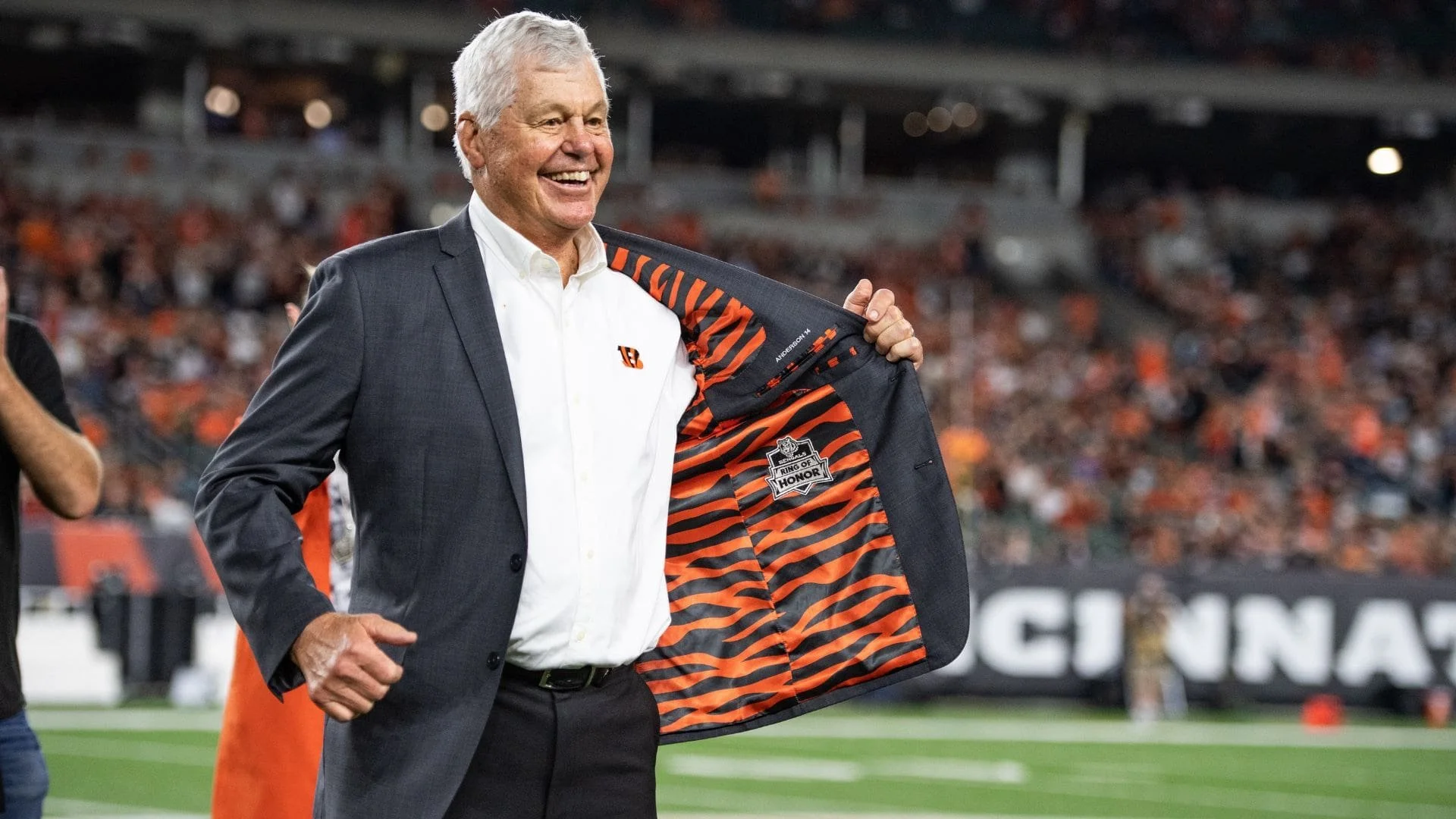
Ken Anderson belongs in the Pro Football Hall of Fame. Period.
But the strongest case for Anderson is not based on hometown loyalty. It is based on how his career compares with quarterbacks already enshrined in Canton, the distinction of being named the NFL’s Most Valuable Player, his role in the evolution of the modern passing game, and a community legacy recognized by the NFL itself more than 50 years ago.
In fact, Anderson has now moved closer to Canton than ever before.
He was one of only three Senior player finalists for the Pro Football Hall of Fame Class of 2026, selected from an initial pool of 182 Senior candidates. He ultimately fell short of the required vote for induction, but under Hall of Fame rules, his advancement so deep into the 2026 process automatically moves him to the finalist stage again for the Class of 2027.
That makes this an ideal moment to reconsider Anderson’s career based on the evidence.
Start With the Numbers
Anderson played all 16 of his NFL seasons with Cincinnati from 1971 through 1986.
His career totals:
32,838 passing yards
197 touchdown passes
2,654 completions
59.3 percent completion rate
81.9 career passer rating
192 games played
91 career victories as a starting quarterback
Four Pro Bowls
First-Team All-Pro in 1981
1981 AP NFL Most Valuable Player
He remains the Bengals’ career leader in passing yards, completions and touchdown passes. But let’s evaluate those stats in the context of his era.
The NFL of the 1970s and early 1980s was not the passing league fans know today. Quarterbacks threw fewer passes, defensive backs had greater freedom to make contact with receivers and completion percentages were dramatically lower.
Anderson excelled anyway.
He led the entire NFL in passing yards in 1974 and 1975.
More impressively, he led the league in passer rating four times, one of the clearest measures of sustained dominance relative to his contemporaries.
Then consider 1982.
Anderson completed 70.6 percent of his passes, an extraordinary figure for the period. NFL records show him completing 218 of 309 attempts that season with a 95.3 passer rating. That completion rate established an NFL single-season record that stood until Drew Brees surpassed it in 2009. Which means Anderson was completing passes at what today would be considered elite efficiency nearly three decades before the modern passing explosion.
The MVP Argument Is Difficult to Ignore
The strongest individual line on Anderson’s résumé may be three letters: MVP.
In 1981, Anderson was named the Associated Press NFL Most Valuable Player. That season he led Cincinnati to a 12-4 record, the AFC championship and the franchise’s first Super Bowl appearance. He was also named NFL Offensive Player of the Year and Comeback Player of the Year.
There is an important distinction here – Super Bowls are team accomplishments.
An NFL MVP award says that, for one full season, voters considered a player the best or most valuable player in professional football.
Anderson has one, many Hall of Famers never won one.
Compare Him With Quarterbacks Already in Canton
Hall of Fame debates become more meaningful when candidates are compared with players from approximately the same era.
Consider several quarterbacks already enshrined.
Joe Namath: 173 touchdown passes and 220 interceptions.
Ken Stabler: 27,938 passing yards and 194 touchdown passes.
Bob Griese: 25,092 passing yards and 192 touchdown passes.
Dan Fouts: 43,040 passing yards and 254 touchdown passes.
Anderson finished with 32,838 yards, 197 touchdowns and only 160 interceptions. He threw for more career yards than Stabler, Namath and Griese. He threw more touchdown passes than Namath, Stabler and Griese. And unlike Namath and Stabler, Anderson finished his career with significantly more touchdown passes than interceptions.
Championships understandably elevate the résumés of Namath, Stabler and Griese. But Dan Fouts provides another useful comparison because he never reached a Super Bowl. Fouts was a brilliant passer and unquestionably deserving Hall of Famer. His career passing volume exceeded Anderson’s. But Anderson possesses honors Fouts does not, including an AP NFL MVP award.
The comparison is not meant to argue that any of those quarterbacks do not belong in Canton. But does raise the question.
If those accomplishments establish Hall of Fame standards, how can Anderson’s complete body of work remain outside?
Even the Hall of Fame Metrics Put Him in the Conversation
Pro Football Reference's Hall of Fame Monitor is designed to compare players’ credentials with others at their positions. Anderson currently scores 82.99 on its quarterback Hall of Fame Monitor. For context, Hall of Fame quarterback Bob Griese scores 73.00.
The metric is not an official Hall of Fame voting formula, but it reinforces something Anderson supporters have argued for years.
His candidacy is not sentimental. Statistically, he lives in Hall of Fame territory.
M.V.P.
Technically, this is where an important distinction should be made. The Pro Football Hall of Fame is not the NFL Man of the Year Award. A player should not be inducted primarily because of his philanthropic work.
The Hall's responsibility is to preserve the history of professional football and recognize exceptional football careers.
But the case for Anderson begins with MVP:
Four passing-rating titles.
Two passing-yardage titles.
A Super Bowl appearance.
Four Pro Bowls.
First-Team All-Pro.
Nearly 33,000 passing yards in a less pass-oriented era.
A landmark completion-percentage record.
And a role in the development of offensive concepts that helped reshape professional football.
The philanthropy does something different. It completes the portrait.
Anderson Also Helped Change How Quarterback Was Played
There is another dimension to Anderson's football legacy that raw career totals do not capture.
During Anderson’s early years in Cincinnati, assistant coach Bill Walsh was developing the short, precise, timing-based passing concepts that would eventually become famous as the West Coast offense. Walsh later achieved football immortality in San Francisco with Joe Montana.
But many of those concepts were being developed and executed in Cincinnati first, with Anderson operating the offense. Anderson’s accuracy, decision-making and ability to distribute the football made him particularly well suited to an offense built on timing and precision.
That history gives Anderson’s career a significance beyond statistics. He was not simply successful within an existing NFL system. He was one of the quarterbacks demonstrating that a different style of passing offense could work.
How the Hall of Fame Senior Process Actually Works
Anderson’s path to Canton is now through the Hall’s Seniors category, which exists for players whose careers ended long enough ago that they are no longer considered alongside Modern-Era candidates.
For the Class of 2026, the process began with 182 Senior nominees. The field was reduced repeatedly:182 nominees. Then 52. Then 34. Then nine semifinalists. Finally, the Hall’s nine-person Seniors Blue-Ribbon Committee selected just three Senior finalists: Ken Anderson, Roger Craig and L.C. Greenwood.
At the final stage, those three players were grouped with Coach finalist Bill Belichick and Contributor finalist Robert Kraft. Each member of the Hall's full Selection Committee could vote for only three of those five candidates. A candidate generally needed approval from at least 80 percent of the Selection Committee to be elected. A maximum of three could make the Hall from that group.
Only Roger Craig was elected from the group for 2026.
That context is significant. Anderson wasn’t eliminated among dozens of former players. He survived every reduction until he was one of the final three Senior players being debated for Canton.
And there is now another major development in his favor.
Because Anderson reached the final seven players considered for the Class of 2026 but did not receive the required 80 percent vote, the Hall's bylaws automatically advance him to the finalist stage for the Class of 2027.
His candidacy has effectively moved from “Should Ken Anderson be considered?” to “Does Ken Anderson finally receive enough votes?”
Then There Is the Other NFL Honor on His Résumé
The football statistics could make the Hall of Fame case by themselves. But Anderson possesses another distinction that makes his legacy especially compelling today.
In 1975, Ken Anderson was named the NFL Man of the Year. The award was later renamed the Walter Payton NFL Man of the Year Award. Today it is one of the NFL’s most visible honors, recognizing a player’s commitment to community service along with excellence on the football field.
Look at the winners surrounding Anderson in the award’s early history:
Johnny Unitas.
Willie Lanier.
Len Dawson.
George Blanda.
Ken Anderson.
Franco Harris.
Walter Payton.
Roger Staubach.
Those names reinforce the stature the honor already carried. And Anderson’s 1975 season makes the achievement even more remarkable. That same year he led the NFL in passing yards. In other words, Anderson was simultaneously recognized for excellence as one of football's best quarterbacks and for the way he represented the league away from the field.
Fifty Years Later, the Man of the Year Story Is Still Being Written
For Anderson, community service was not something that ended when his playing career did.
He later helped establish the Ken Anderson Alliance, inspired in part by the challenges experienced by his nephew Drew, who has autism.
The Cincinnati-based nonprofit works with adults with disabilities through employment opportunities, social engagement, creative arts and community programs. Its scale has grown substantially.
The organization’s most recently available Form 990 data reported approximately $1.59 million in annual revenue, along with more than $1.5 million in net assets.
That makes Anderson’s philanthropy more than a ceremonial celebrity foundation. It has developed into a substantial Cincinnati nonprofit organization providing continuing services to adults with disabilities. The connection to Anderson's 1975 NFL honor is striking. More than five decades after being named the league’s Man of the Year, he continues to embody the values that award now represents.
A Rare Double Legacy
NFL.com has itself previously made the case that Anderson deserves Hall of Fame consideration, noting the unusual combination of being an MVP, Comeback Player of the Year and Walter Payton Man of the Year winner while also leading the league in passer rating four times.
That combination may be the most compelling way to understand Anderson today. He reached the pinnacle of his profession. He helped take Cincinnati to its first Super Bowl. He was judged the best player in the league.He played quarterback with an efficiency years ahead of his time.And the NFL also honored him for what he represented beyond football. Then he spent decades proving that recognition wasn’t temporary.
Ken Anderson has already built a Hall of Fame resume. Canton simply hasn’t put the bust in the room yet.
– Jackie Reau