Big Shoes to Fill

Brian Planitz, author of
“William Howard Taft in Cincinnati”
The road. The theatre. The museum. The other museum. Not to mention a law firm, a broadcasting company, and a high school.
The Taft name runs through this city.
In a new book, author Brian Planitz examines “William Howard Taft in Cincinnati,” bringing to life Taft’s time in his hometown and how it shaped his later career in Washington, D.C., and around the world.
Planitz worked for the William Howard Taft National Historic Site from 2007 to 2013 which fueled his interest in Taft and provided an ideal place for research and reflection.
Most Americans know that William Howard Taft was president of the United States and chief justice of the Supreme Court. But his life and legacy contain much beyond that, especially in his hometown.
Planitz did much of his research at the William Howard Taft National Historic Site.
“It has a lot of useful letters from the Taft collection that were luckily transcribed!,” he says. “It is amazing how ‘sloppy’ 19th-century handwriting can be – It makes doctor’s prescription look like bold print!”
The Site also has folders of the day-by-day life of the Tafts that proved invaluable. Planitz also credits the The Public Library of Cincinnati and Hamilton County for both its extensive research databases. Most of the photographs in the book are from the Library’s collection and newspaper databases, which are available to library.
“It makes research look too easy, but that is what it is there for,” says Planitz.
What piqued your interest in writing a book about William Howard Taft right now?
I started this project in Fall 2010, when I was an undergraduate at Mount Saint Joseph University.
It was born as my American History Seminar thesis paper. My professor gave us a simple statement on how to choose a topic: “Pick something you can get out of bed and write about every day.” At the time, (working at) the National Park Service (NPS), I knew I could that with William Howard Taft. The question was on what topic.
Taft was more judicial than political, as most people know. He loved the law, he loved being a judge. I figured I would look at his judicial career, which mostly takes place in Cincinnati, and I titled it “The True Path” because he was really good at being a courtroom lawyer and had a passion and love for the work. When I graduated with my M.A. from Northern Kentucky University, I looked at publishing it then, and morphing it into his life in Cincinnati life more generally. But I put it on thee back burner because things just were not lining up at the time.
In June 2023 I was working at my job and the bug in the ear just got louder over the years to finish the project. I contacted my publisher, Arcadia Publishing/The History Press, and put things in motion to get it finished! However, my original work had been lost, so I had to completely rewrite the manuscript. Between working two jobs and medical situations, the process took a long time, but the book was finally published a few weeks ago.
Where do you still see the Taft family’s legacy in law in the city today?
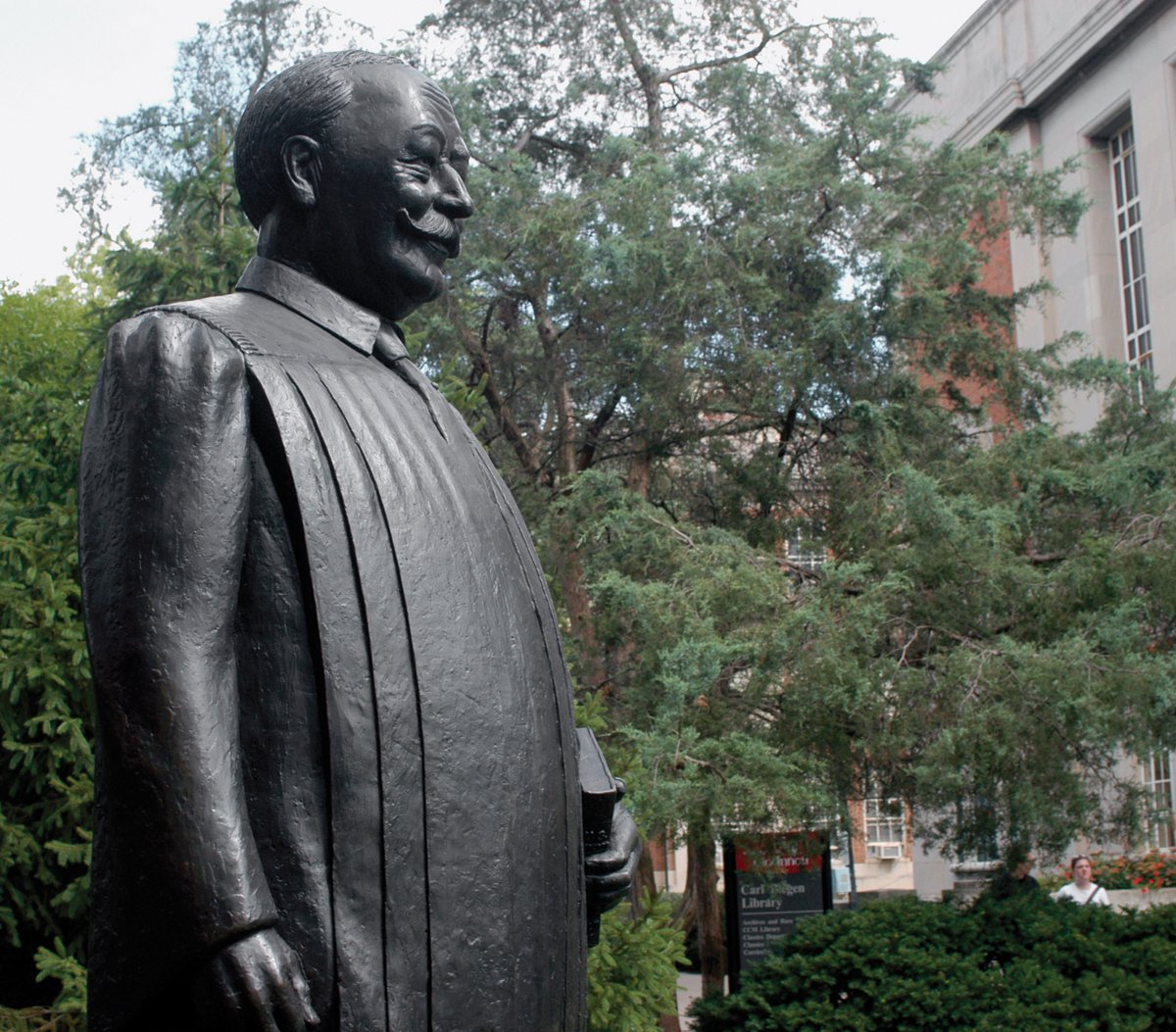
Taft statue at the University of Cincinnati. Courtesy UC.
You cannot go more than a few miles without a direct or indirect connection to something William talked about, or where he lived, visited, worked, or played.
The William Howard Taft National Historic Site (Taft birthplace) is the main legacy for him, unfortunately it’s the only site, museum, library of him specifically, opened to the public.
A few homes still exist but are private residences. Of course the Taft Museum of Art is one of those, even though it is not directly tied to him, he has a strong connection to the museum.
During the 1908 Presidential Election, postcards of the Taft Museum of Art exist which clearly say, “William Howard Taft Residence.” I can only speculate, that since he did not have a residence in Cincinnati at the time, Charles and Anna’s house looked “presidential” and impressive to voters.
Most people who looked at that postcard would never know that William worked multiple jobs at many times in his life, especially when he lived in Cincinnati. He had to take a loan out from his aunt in Massachusetts to complete the home he and Nellie lived in when they got married, and of course had to pay it back!
The University of Cincinnati College of Law exists today because of William Howard Taft. As dean, he merged his alma mater, the Cincinnati College of Law, with the new University Law Department at UC in the late 1890s and served as dean until 1900.
The family has faded from politics over the last 20 years; however, they have never stepped away from the law. The family has members all around the country, involved with community projects and legal work.
How do you think the city’s appreciation for the arts influenced him?
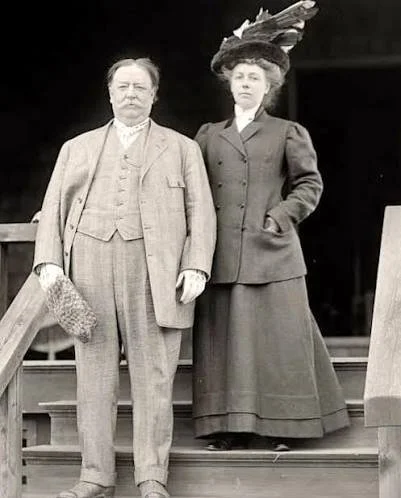
When he was younger, William would go on dates to the theater and concerts. At a reading salon he met and fell in love with Helen “Nellie” Herron, who he married.
He appreciated the mark the arts made on Cincinnati.
Nellie, helped create what we now know as the Cincinnati Symphony Orchestra. He supported the May Festival at Music Hall and dedicated a statue there as well. Music was not something he knew a lot about but grew to enjoy its deeper meanings in the city and its importance in local society.
Charles Phelps Taft and his wife, Anna, created the Taft Museum of Art. William would stay with them in the house on Pike Street when he would return to Cincinnati after 1900, surrounded by the art. All the members of the Taft family understood what the gift of cherished artworks meant to the city.
William may not have had as much artistic knowledge as his brother, but if it bettered Cincinnati, that’s all it took for him to get behind anything in the arts.
What in Taft’s work could we use as advice in our politically challenging time?
Taft was seen as a party-first Republican during the elections of 1908 and 1912 . However, what the Republican Party didn’t understand that Taft was a Progressive like Roosevelt but he wanted things done the way the law was written.
In today’s political arena, speed is the key. Dramatic speeches from both sides of the aisle to sway votes go a long way with the media and many voters. Taft’s predecessor, Theodore Roosevelt had a saying: “Unless I can’t, I will.” How he did it didn’t matter, as long as he did something. Roosevelt used what was not explicitly written in the Constitution and took advantage of that through his Executive Orders.
Taft also had a saying: “Action for which I become responsible, or for which my administration becomes responsible, shall be within the law.” Taft did not believe in doing anything not explicitly written in the Constitution. Sometimes its best to be a Theodore Roosevelt-type president, but you also need to make sure you have a William Howard Taft-type president to balance and slow things down when the world seems to be going very fast around you.
Taft was very down-to-earth, calm, and judicial. He wasn’t good at the game of politics. But he was great at staying who he was while in the White House. He didn’t change who he was.
Are you interested in exploring more the the family’s history in other books?
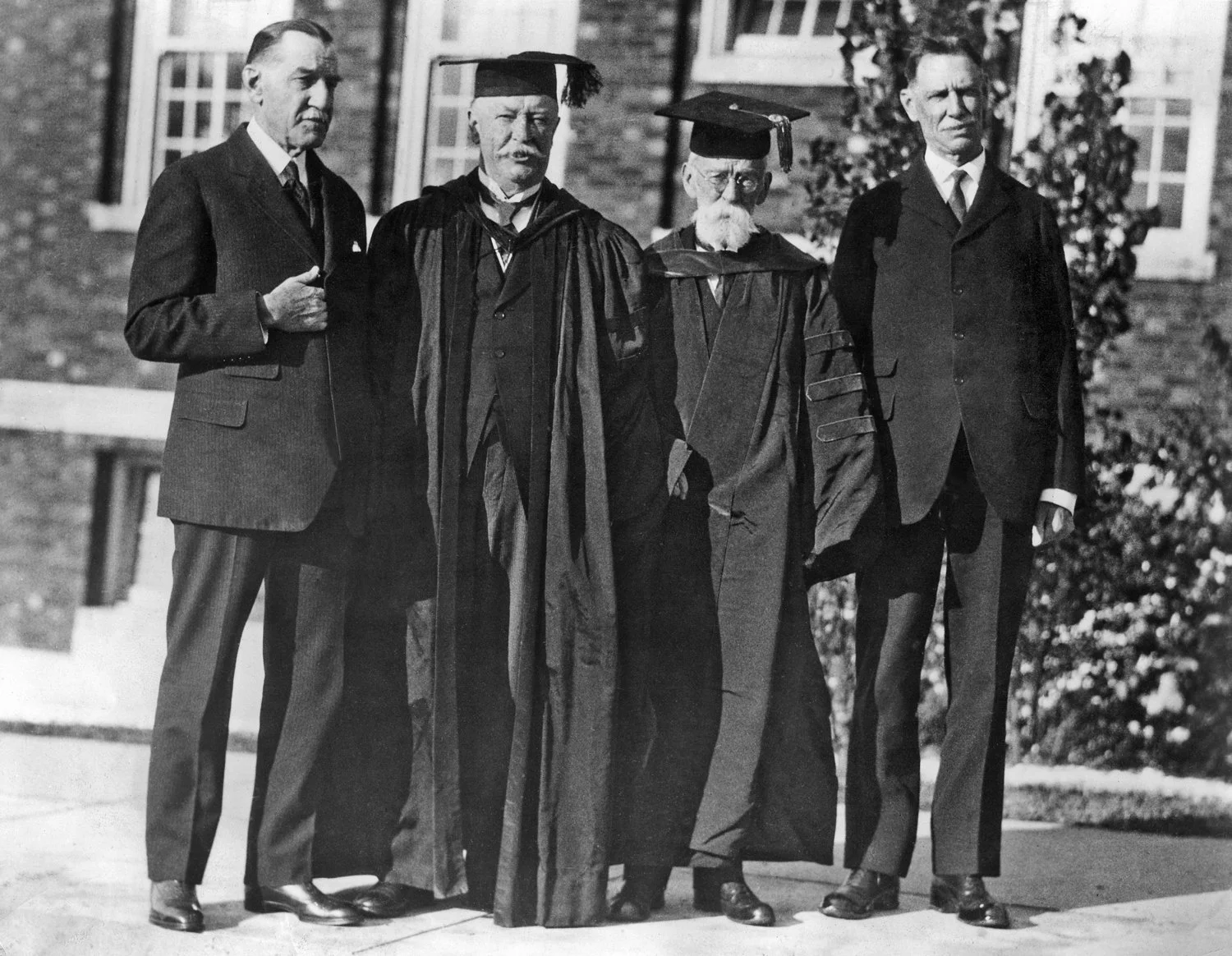
Gathered for the 1925 dedication of Alphonso Taft Hall were his sons (from left): Henry, a prominent New York attorney; former president William Howard, chief justice of the U.S. Supreme Court; Charles Phelps, publisher of the Cincinnati Times-Star and former Ohio congressman; and Horace, founder and headmaster of a private boarding school in Connecticut. Courtesy UC.
I have thought about other members of the family, particularly, Alphonso Taft. Leonard Lewis wrote a biography of him in the 1920s and it has long been out of print.
Alphonso is one of the few fathers of presidents who lived a very long and public life like their sons. The other that come to mind are John and John Quincy Adams and George H.W. and George W. Bush – But usually fathers who were not presidents kept a low profile! Alphonso had a public life Cincinnati as a judge, running for governor of Ohio, and acting as Secretary of War and Attorney General for President Grant, and Ambassador to the Austria Hungarian Empire and Ambassador to Russia for President Chester Arthur.
My Taft “library” sits at around 36 titles, and I am happy to have added to that list. Knowing I have contributed to this family as a whole and William in particular is gratifying.
– Tricia Suit